VIEWS AND LESSONS FROM PETER BUSHNELL
My Take on Health & Safety
Ideas, experience and lessons worth talking about. A little history and humour can help us look again at the work we do today.
Recent pieces: We’ve done it before—but did we learn? · Getting Used to It Doesn’t Make It Safe · It was only a little knock · My View on Health & Safety · It hasn’t happened here · Who’s moved the teabags? · Start a conversation · Follow the time · On Blame · Just Fly The Plane
History lessons
Start with my introduction: A Safer Tomorrow.
Eight stories, each with the same approach: Then → Today → My Take. Read the posters, use the questions to start a conversation, and follow the sources to explore further.
01 · Gravity hasn’t changed
02 · Supervision isn’t new
03 · Does it actually protect?
04 · Stopped doesn’t mean safe
05 · From survival to safety
06 · Installed isn’t enough
07 · When rules meet pay pressure
08 · Protection starts with understanding
The illustrations are reconstructions or illustrative scenarios. These are historical comparisons, not claims that past workplaces met modern standards.
It was only a little knock.
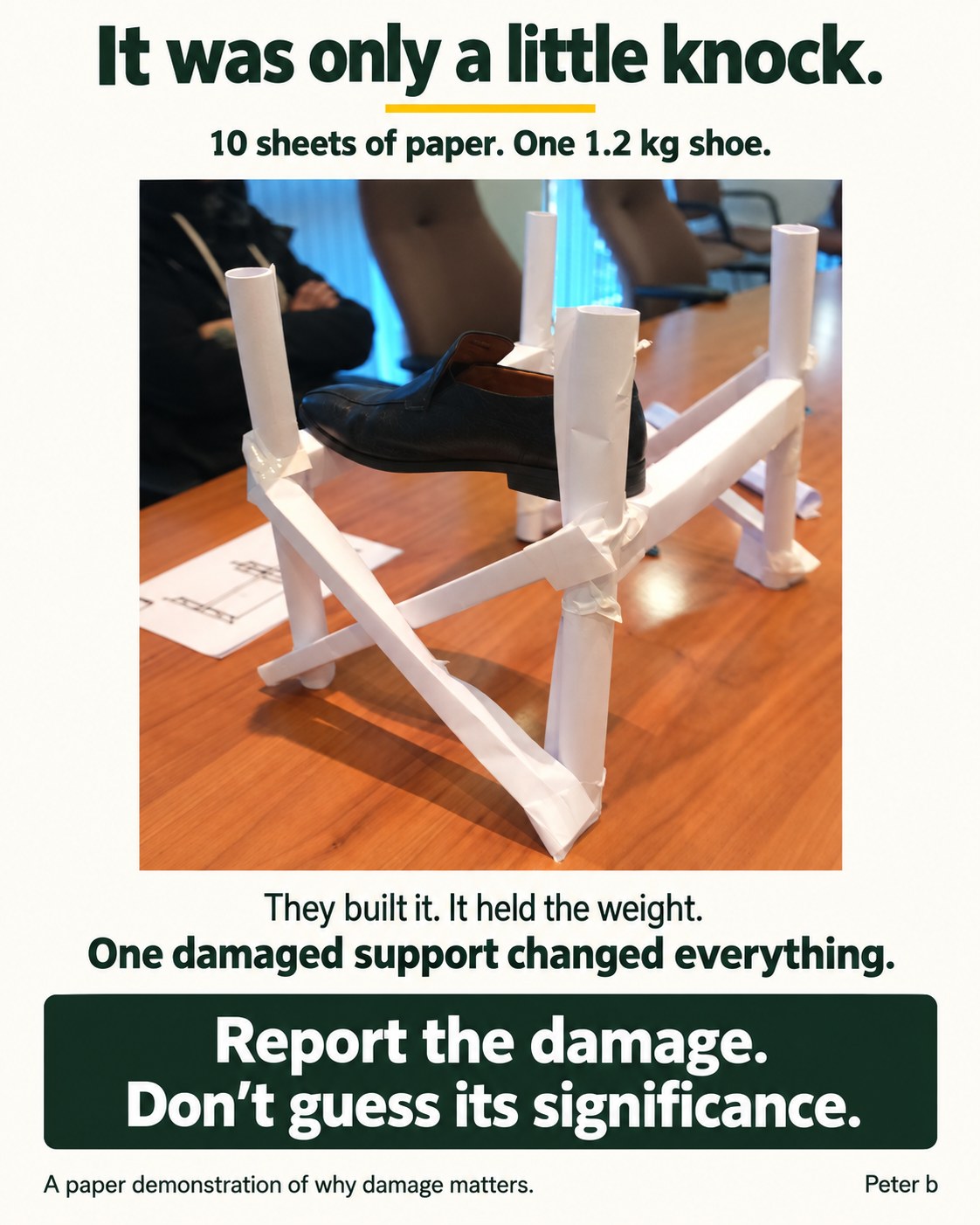
Ten sheets of A3 paper. One shoe weighing 1.2 kg.
During a training session, we built a small paper rack to explore where its strength came from.
It held the shoe. Quite successfully.
They had built it themselves and seen it work. I’d also acquired a shoe rack, which was a bonus.
Then I flicked one of the supports, creasing the paper.
The structure fell.
That was the part of the lesson I wanted them to remember.
We talked about what happens when someone damages a racking upright and doesn’t report it. Something that looked strong a moment ago had lost strength through damage to one part.
Of course, paper isn’t steel. This wasn’t a test of warehouse racking or a claim that every dent causes a collapse. It was a way of making the importance of damage visible.
Don’t assume a knock is harmless because the rack is still standing. Report it so it can be assessed.
This is how I like to teach. Give people something to work through, help them discover what matters, then discuss what it means for their own workplace.
Building it showed them where the strength came from.
One flick showed them why reporting damage mattered.
Peter b
My View on Health & Safety
You cannot build lasting health and safety through enforcement alone. You cannot stand over people every minute of the day. As the old saying goes, “The beatings will continue until morale improves.” We all know how well that approach works!
I’ve always believed that health and safety should be understood as part of how a business works. It connects with quality, morale, respect, time, cost, production and profit. Decisions about any of these can affect the others—and the people doing the work.
Different roles bring different pressures and priorities. Someone is trying to get an order out. Someone else is managing a budget, sorting a quality problem or arranging cover for an absent colleague. Preventing injury and ill health belongs in those decisions.
My approach is to bring the people involved into the same conversation and help them see those connections. What does a decision mean for the next person, the next department or the next shift?
Rather than trying to make people care about health and safety, help them understand how health and safety affects the things they already care about.
Food factories give me a useful example. In factories where I’ve worked, walk onto the shop floor without a hairnet and someone will soon tell you to put one on. It might be a manager, an experienced operator or someone who has only recently joined.
Just about everyone, including the cat, would probably remind you—although we would need a separate conversation about why the cat was in the factory!
People understand the expectation and reinforce it between themselves. It has become part of how the place works.
Imagine that same shared expectation across health and safety: people noticing, speaking up and looking out for one another.
That takes more than telling people to care. They need to understand what is expected, why it matters and how to put it into practice. Sometimes, that means questioning what we have explained ourselves.
I once stopped a forklift driver with the transport manager because the driver was wearing a big black coat. When we asked where his high-vis was, he indignantly took off his coat to show us.
He was wearing it—underneath.
At first, we laughed a little, and the transport manager explained that the high-vis needed to be on the outside. But afterwards, I thought about what we had actually told him.
We had said he must wear high-vis. Had we explained why, or that it needed to be visible?
We employed people from different countries and backgrounds. Something familiar to me might be completely new to someone else.
He had followed the instruction as he understood it. I had assumed the rest.
That was a lesson for me: explain the purpose, and check the understanding.
People also need the time, equipment and management support to act on that understanding—especially when doing so interrupts production.
If we tell someone to report a fault, then make their life difficult when they do, we have taught them something. It probably wasn’t the lesson on the poster.
Equally, if someone keeps struggling with a procedure, we need to ask why. Is it clear? Have they been shown properly? Does it fit the job? Are we asking them to meet expectations that conflict with one another?
Rules, procedures and supervision all have a place. They should support a workplace where people understand the consequences of their decisions, take responsibility for their work and feel able to challenge something that isn’t right, regardless of who is doing it.
That includes challenging me. If I’ve missed something, I would rather be told before somebody gets hurt.
Real success is when people understand why the right action matters, have the support to take it and know their concerns will be taken seriously.
And perhaps one of the best signs of a good health and safety culture is what happens when the H&S manager isn’t there.
Peter b
MY TAKE · PLANS AND ASSUMPTIONS
It hasn’t happened here—what does that tell us?
By Peter b
“We’ve never had a problem.”
That is worth knowing. My next question is: what has helped keep it that way?
Perhaps the arrangements work well. Perhaps staff regularly spot problems and put them right. Perhaps some of the conditions that would expose a weakness haven’t occurred together yet. A quiet history, on its own, doesn’t tell us which.
I’m interested in what we are relying on—and whether we have checked it.
A few ordinary questions
- What if the person who normally makes the decision is away?
- What if our usual way of communicating is unavailable?
- What if someone needs assistance we hadn’t anticipated?
- What if the preferred exit or assembly point cannot be used?
We don’t have to begin with the most frightening event we can imagine. A realistic change to an ordinary assumption can open a useful discussion.
The people doing the work bring something important
During a tabletop exercise at a swimming pool, a lifeguard explained that the session included older swimmers. The proposed exit led onto grass. We were exploring winter conditions.
Wet swimmers, swimming costumes and snow. That observation gave us something practical to work through.
We paused, discussed the gap and agreed actions. Read the full pool example.
Where the Black Swan idea fits
Nassim Nicholas Taleb’s Black Swan idea concerns events outside expectations, with extreme impact, that people explain afterwards as though they had been predictable. It is more specific than “something rare and serious”. A fire or other recognised hazard does not automatically become a Black Swan because it hasn’t happened at our premises.
For me, the useful question is how we respond when our expectations are incomplete. We cannot write a script for every possible event. We can examine dependencies, clarify responsibilities, consider alternatives and practise working through decisions together.
That thinking supports preparation for known hazards too. It does not replace the practical checks those hazards need.
What happens after the conversation matters
A TTX gives us time to question, learn and identify actions. Discussing a radio call does not prove the radio works. Agreeing an action does not mean it has been completed. We need to follow through and check.
You know your workplace. Let’s explore what happens when the day doesn’t follow the plan.
See how a tabletop exercise works and what you take away, or talk to me about your team.
Background reading: Taleb’s introduction to The Black Swan. The workplace examples and interpretation above are my own.
Who’s moved the teabags?
By Peter b
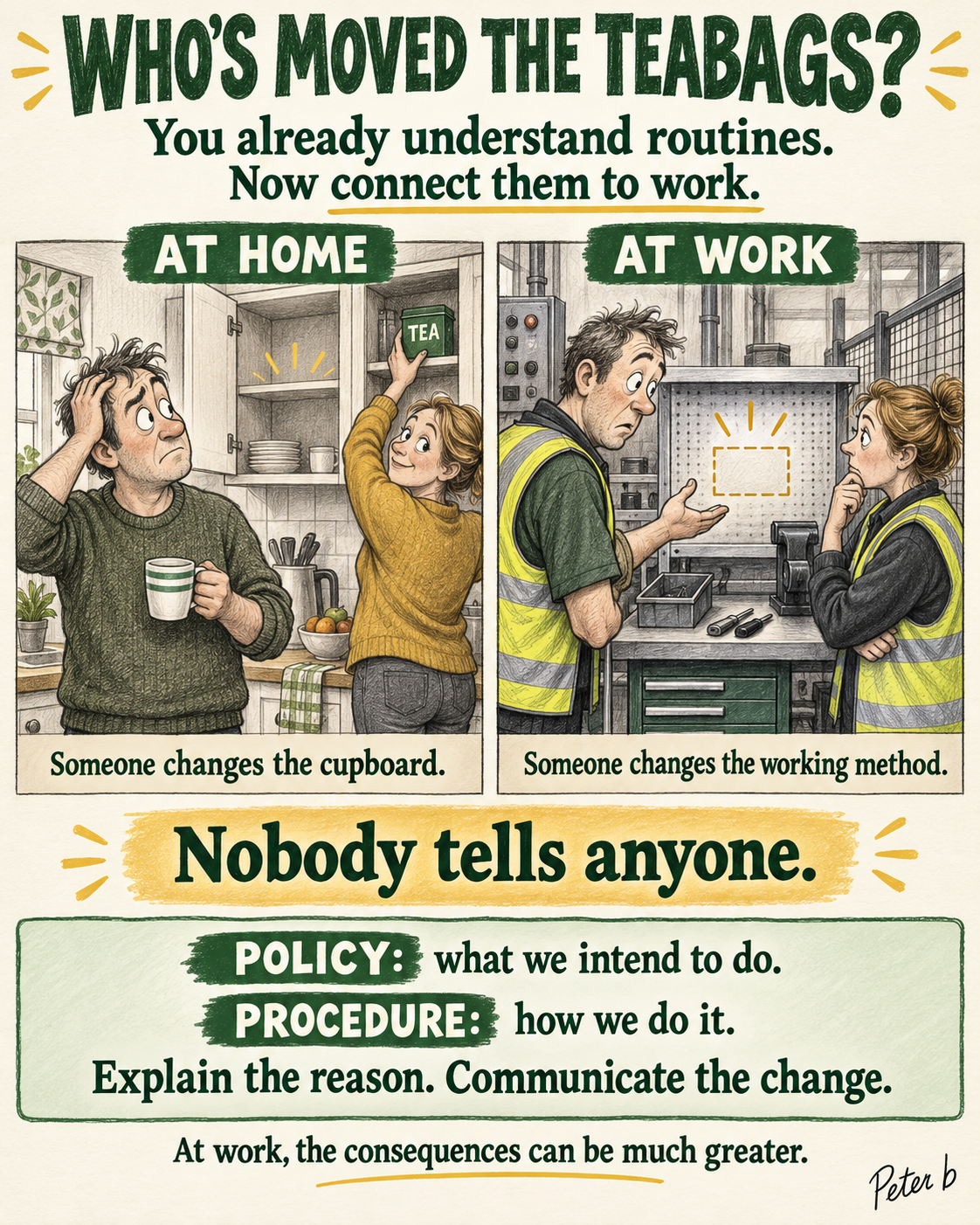
“Who’s moved the teabags?”
A small question. Sometimes delivered with considerable feeling.
At home, we have agreed places for things and familiar ways of doing jobs. We might never write them down, but we certainly notice when someone changes them without telling us.
The teabags live in that cupboard. The mugs go over there. Everyone knows how to put the kettle on.
Then somebody “improves” the arrangement.
Now we have searching, questions, frustration and somebody explaining that the old way was perfectly good.
Sound familiar at work?
This is one way I like to explain policies and procedures: start with something people already do and understand.
In simple terms, a policy sets out what we intend to do. A procedure explains how we do it.
The connection is shared understanding. People need to know what is expected, why it matters and what has changed.
At home, a moved box of teabags might delay your cuppa. At work, an uncommunicated change to equipment, storage or a working method can have much greater consequences.
Of course, “we’ve always done it like that” doesn’t make a method safe. Workplace arrangements need checking, explaining and reviewing.
But people aren’t arriving at training with empty heads. They bring years of experience of organising, adapting and solving problems.
Use that experience. Make the connection.
I want someone to say, “Now I understand why,” and be able to apply it when they return to the job.
And if you move the teabags, tell someone.
A safety brief should start a conversation
By Peter b
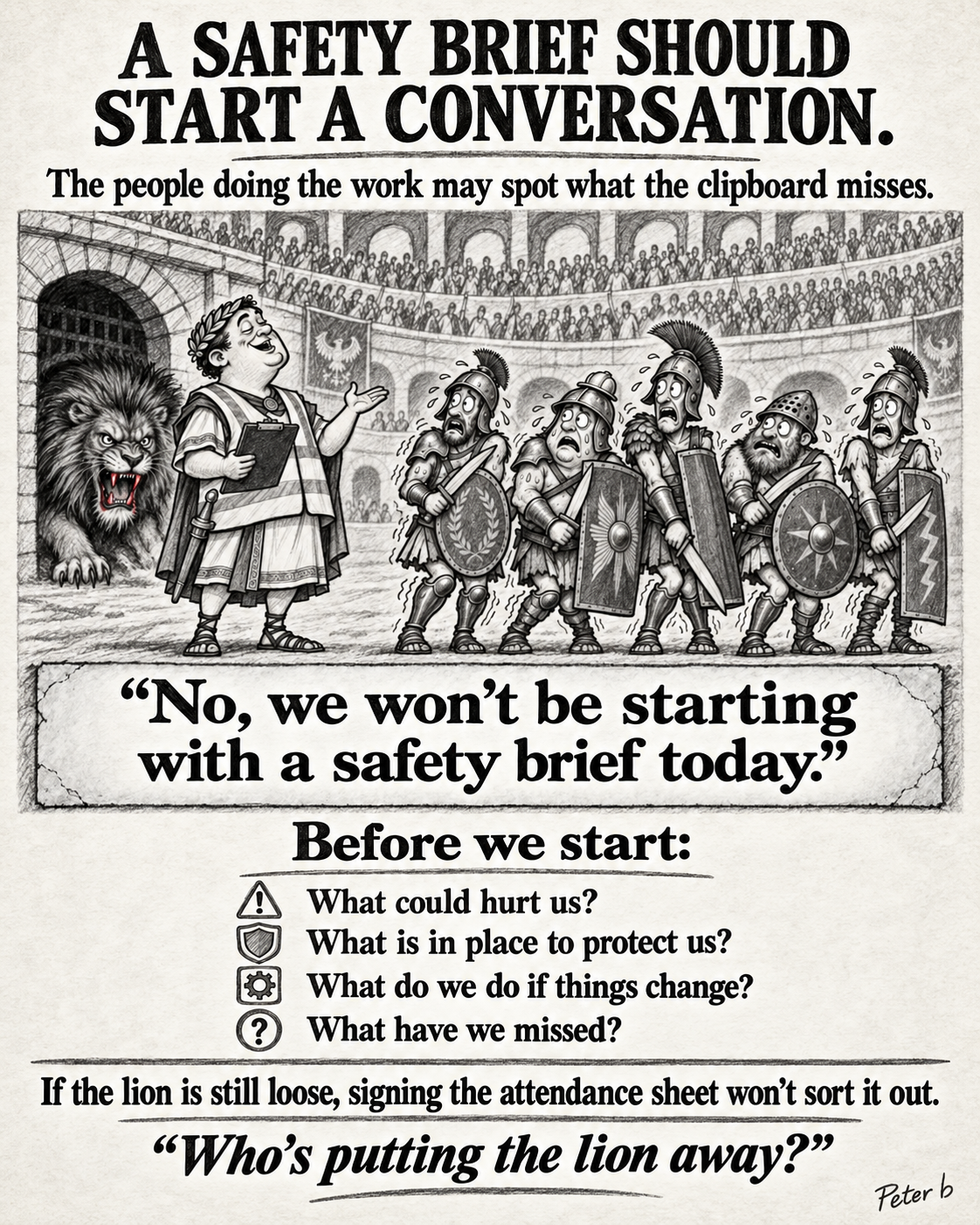
“No, we won’t be starting with a safety brief today.”
Everyone has done this before. They’ve all been issued with PPE. And the lion hasn’t raised any concerns.
A briefing needs to give people a chance to understand the work and speak up about what they can see. The people doing the job may spot something the clipboard has missed.
Before we start: what could hurt us? What is protecting us? What has changed? What have we missed?
Those questions need answers that make sense for the work in front of us. If someone raises a concern, we need to listen and act on it.
A signature on an attendance sheet won’t sort out a loose lion.
Sometimes the most useful contribution is the awkward question nobody has asked yet.
Who’s putting the lion away?
Follow the time
By Peter b
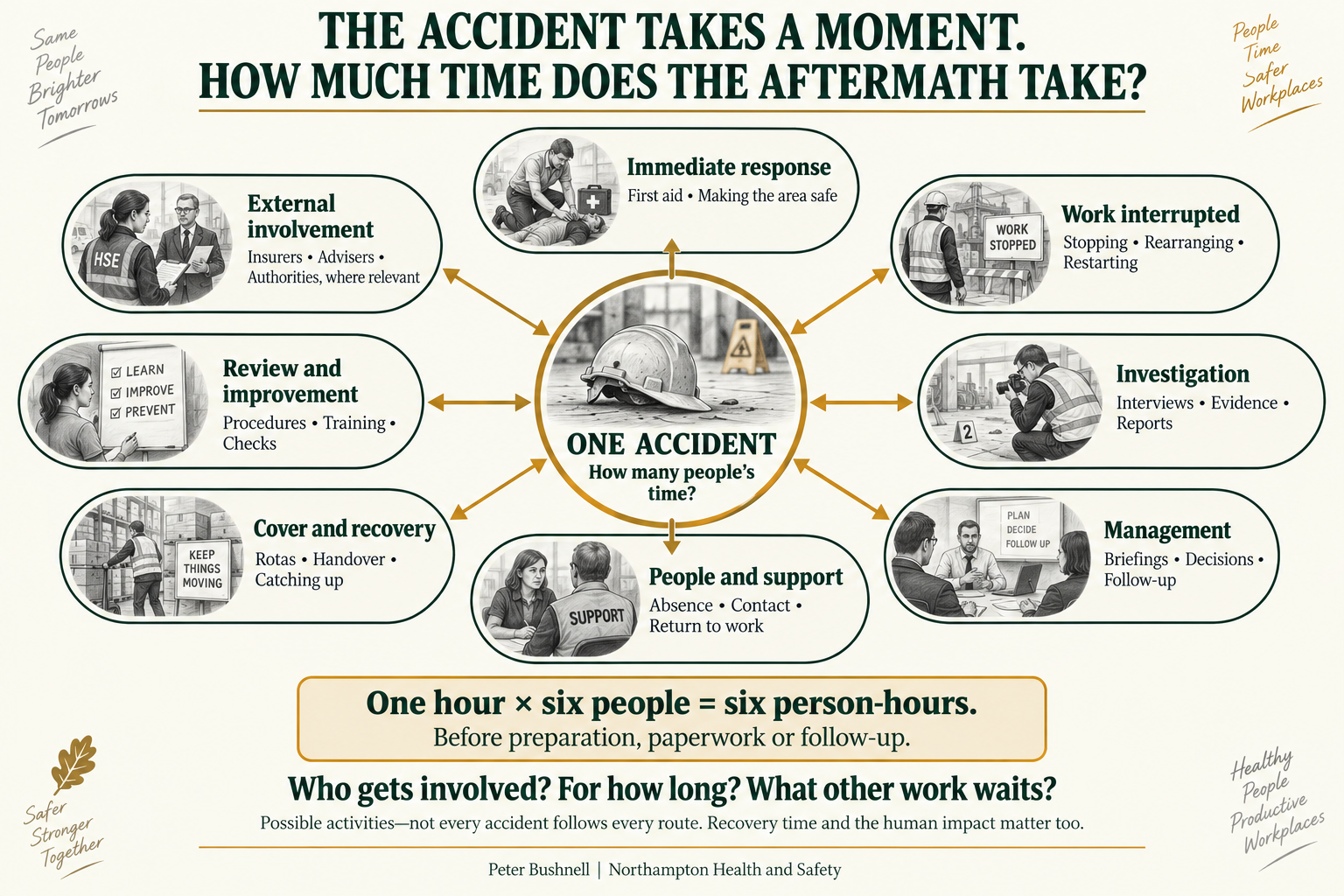
Sometimes, explaining the effect on time and workload helps a manager see a problem they have struggled to engage with.
An accident takes time from more than the person who is hurt. First aid, colleagues, supervision, investigation, HR, arranging cover and getting work going again can all be involved.
These posters make that spread visible without putting a price on an injury.
For a managers’ exercise, choose a scenario. List everyone involved, what each person has to do and how long it could take. Then ask what other work has to wait. Use your own workplace and clearly label estimates.
Keep elapsed time and person-hours separate. Six people each spending an hour means six person-hours, even if those hours happen at the same time. Avoid counting the same person’s time twice.
The time spent dealing with the incident may continue long after work restarts. Recovery is a separate human consequence, not just another entry in the organisation’s workload.
Helping managers understand this is another route to getting prevention taken seriously.
MY TAKE · ON BLAME
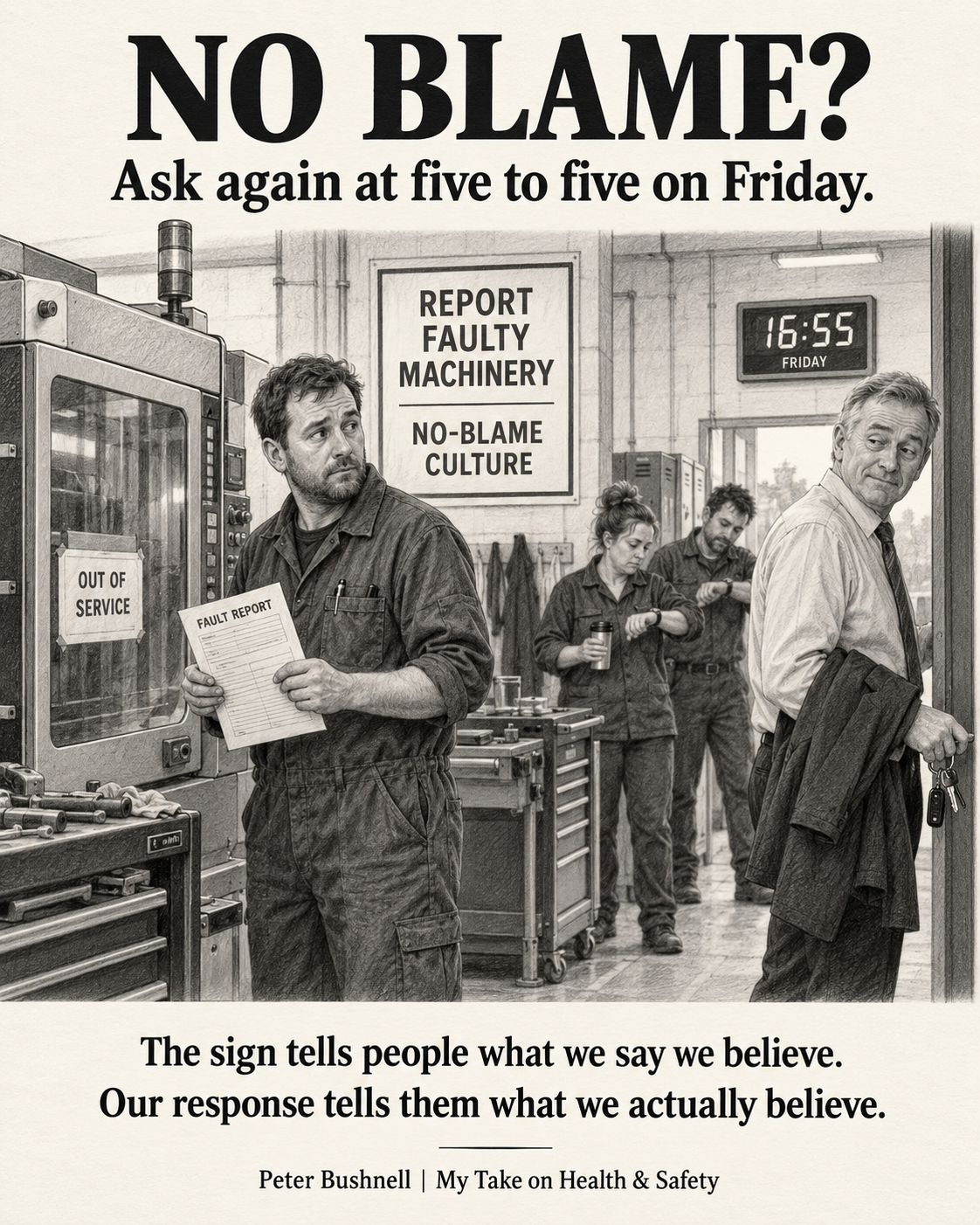
The sign says “no blame”. What does Friday afternoon say?
By Peter Bushnell
“Man can do what he wills but he cannot will what he wills.”
— Arthur Schopenhauer
It’s Friday, just before home time, and my machine has developed a fault.
I can report it. But I know what comes next: management’s reaction, a late finish, and making myself deeply unpopular with a shift who have a prior appointment at the Dog and Duck.
There’s a big sign on the wall:
REPORT ALL INCIDENTS.
REPORT FAULTY MACHINERY.
WE HAVE A NO-BLAME CULTURE.
Lovely. But I’ve seen what happens when someone actually does.
Schopenhauer’s thought gives us a way of looking at that decision. I can choose to report the fault. I can’t simply switch off my wish to get home, my concern about management’s reaction, or my reluctance to let my mates down.
That doesn’t remove my responsibility. But management’s behaviour has helped give those concerns their weight.
People learn very quickly whether the words on the wall match what happens on the floor.
I’ve never been comfortable with “no blame” as a blanket promise. An honest mistake, a lack of training, a repeated problem and deliberate damage all need looking into. They don’t all deserve the same response.
If someone keeps making the same mistake, find out why. Have they been properly trained? Is the equipment right? Are the instructions clear? Are we expecting something unrealistic?
Repetition tells us there is something to investigate. It doesn’t, by itself, tell us the cause.
Accountability has a place too. But even when someone knowingly disregards a safety arrangement, we still need to understand the circumstances. Has the shortcut become normal? Do supervisors tolerate it? Are production targets encouraging it?
We cannot quietly reward a shortcut all week and act astonished when someone takes it on Friday.
Deliberate damage needs a fair response. So does an honest mistake. Fair does not mean identical.
People need clear expectations, concerns taken seriously and confidence that they will be treated fairly.
Reporting a problem should never, by itself, be grounds for punishment.
What I want is a safety ethos: managers who welcome a report, investigate properly, put things right and apply fair standards—including to themselves.
The sign tells people what we say we believe.
Our response at five to five on a Friday tells them what we actually believe.
Quote note: an English rendering of Schopenhauer’s thought, also quoted by Einstein in his 1932 Credo.
A Safer Tomorrow
My take on the history of health and safety
We like to think we’re clever. New equipment, new ideas, new ways of solving problems. But look back through history and you find people wrestling with some very familiar difficulties.
Feet needed protecting. Dust made people ill. Machinery could catch you. People needed warning when something was coming their way.
Take footwear. Putting a barrier between your feet and rough ground is a practical response to a painful problem. I’m not suggesting someone making an early sandal was thinking about modern PPE regulations. They were finding a way to protect their feet and carry on with life.
People could recognise harm and try to prevent it long before they fully understood what caused it.
That doesn’t mean every old solution worked, or that it offered the protection we would expect today. Some helped. Some were based on incomplete explanations. And even a useful precaution depended on someone remembering, maintaining or using it.
That sounds familiar too.
What interests me is the connection between those earlier efforts and the work we do now. What had people noticed? What did they change? Did it help? And what can we learn from it?
We have better materials, scientific knowledge and ways of checking whether protection works. Those are real advances. But we aren’t the first people to realise that sore feet need protecting, dangerous machinery needs guarding, or a warning might prevent someone getting hurt.
The stories on this page explore those connections. They aren’t claims that the past met today’s standards. They are a chance to look at how people responded to the problems in front of them—and to question how well we respond to ours.
The equipment may have changed. The person we’re trying to protect is still a person.
Peter b
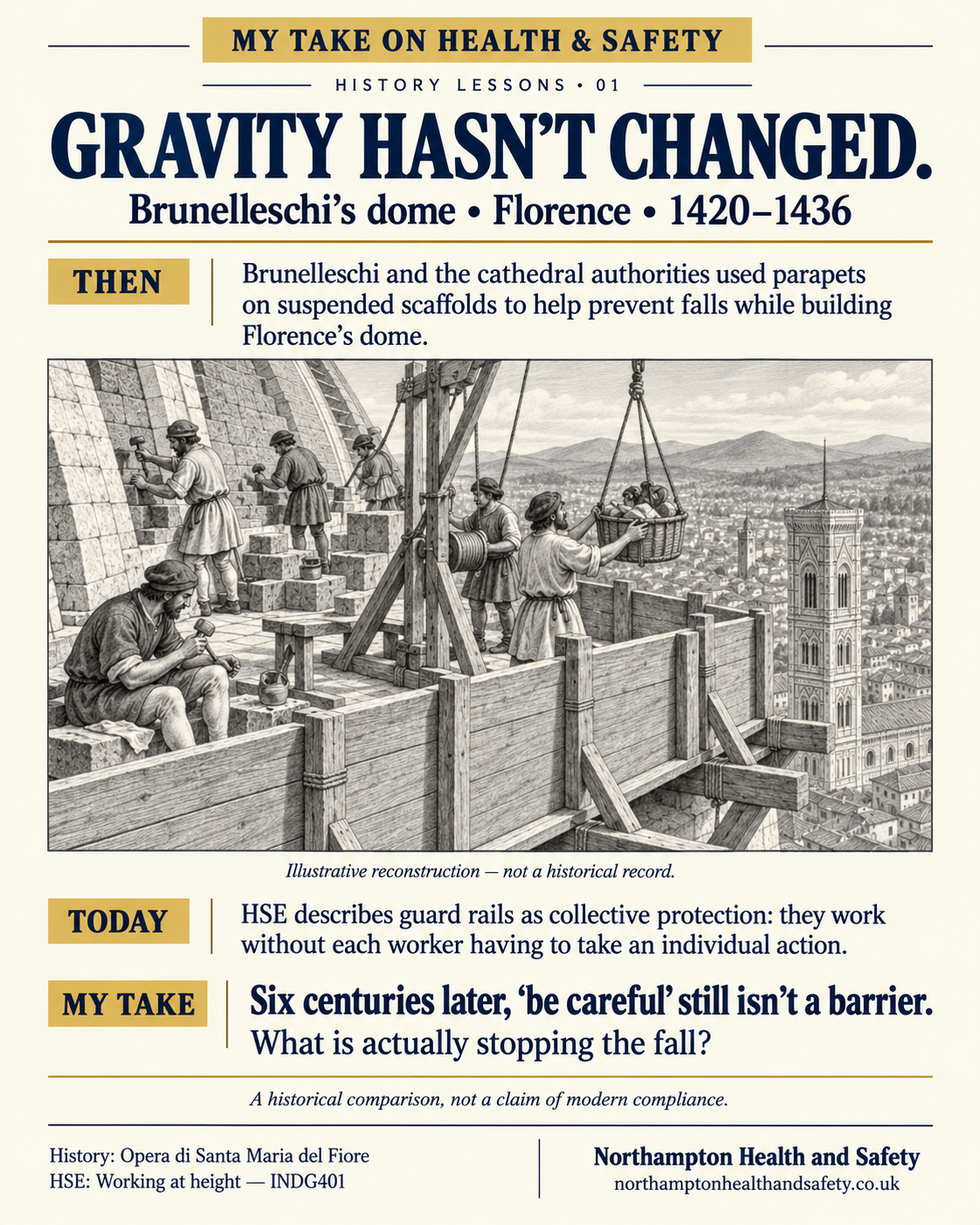
HISTORY LESSONS · 01
Gravity hasn’t changed.
Brunelleschi’s dome · Florence · 1420–1436
Then: Brunelleschi and the cathedral authorities used parapets on suspended scaffolds to help prevent falls while building Florence’s dome.
Today: HSE describes guard rails as collective protection: they work without each worker having to take an individual action.
My take: Six centuries later, “be careful” still isn’t a barrier.
What is actually stopping the fall?
Sources and further reading
Opera di Santa Maria del Fiore: the dome’s construction site
HSE: Working at height — INDG401 (PDF)
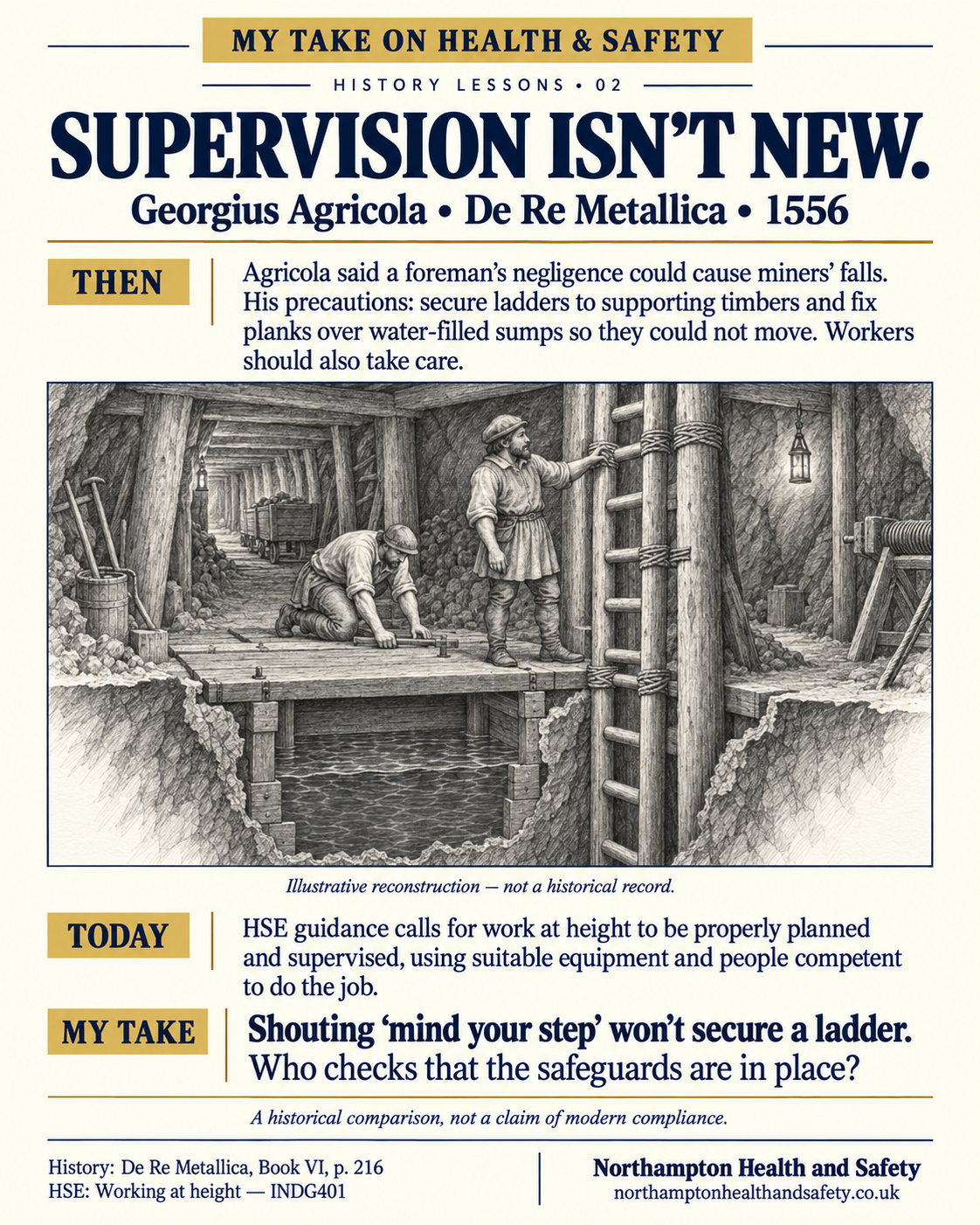
HISTORY LESSONS · 02
Supervision isn’t new.
Georgius Agricola · De Re Metallica · 1556
Then: Agricola said a foreman’s negligence could cause miners’ falls. His precautions: secure ladders to supporting timbers and fix planks over water-filled sumps so they could not move. Workers should also take care.
Today: HSE guidance calls for work at height to be properly planned and supervised, using suitable equipment and people competent to do the job.
My take: Shouting “mind your step” won’t secure a ladder.
Who checks that the safeguards are in place?
Sources and further reading
Agricola: De Re Metallica, Book VI, p. 216 (English translation)
HSE: Working at height — INDG401 (PDF)
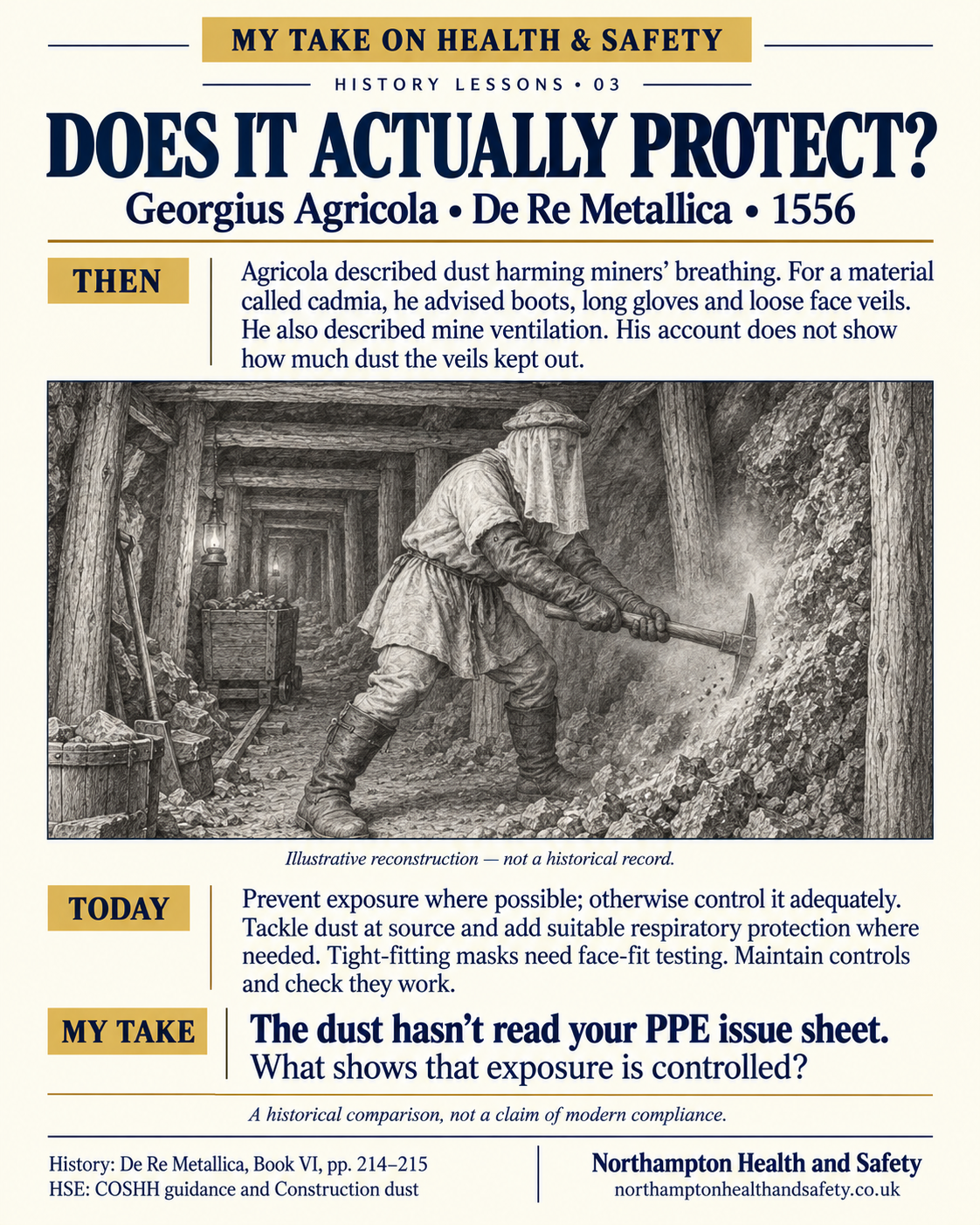
HISTORY LESSONS · 03
Does it actually protect?
Georgius Agricola · De Re Metallica · 1556
Then: Agricola described dust harming miners’ breathing. For a material called cadmia, he advised boots, long gloves and loose face veils. He also described mine ventilation. His account does not show how much dust the veils kept out.
Today: Prevent exposure where possible; otherwise control it adequately. Tackle dust at source and add suitable respiratory protection where needed. Tight-fitting masks need face-fit testing. Maintain controls and check they work.
My take: The dust hasn’t read your PPE issue sheet.
What shows that exposure is controlled?
Sources and further reading
Agricola: De Re Metallica, Book VI, pp. 214–215 (English translation)
HSE: COSHH principles of good control practice
HSE: Construction dust — CIS36 (PDF)
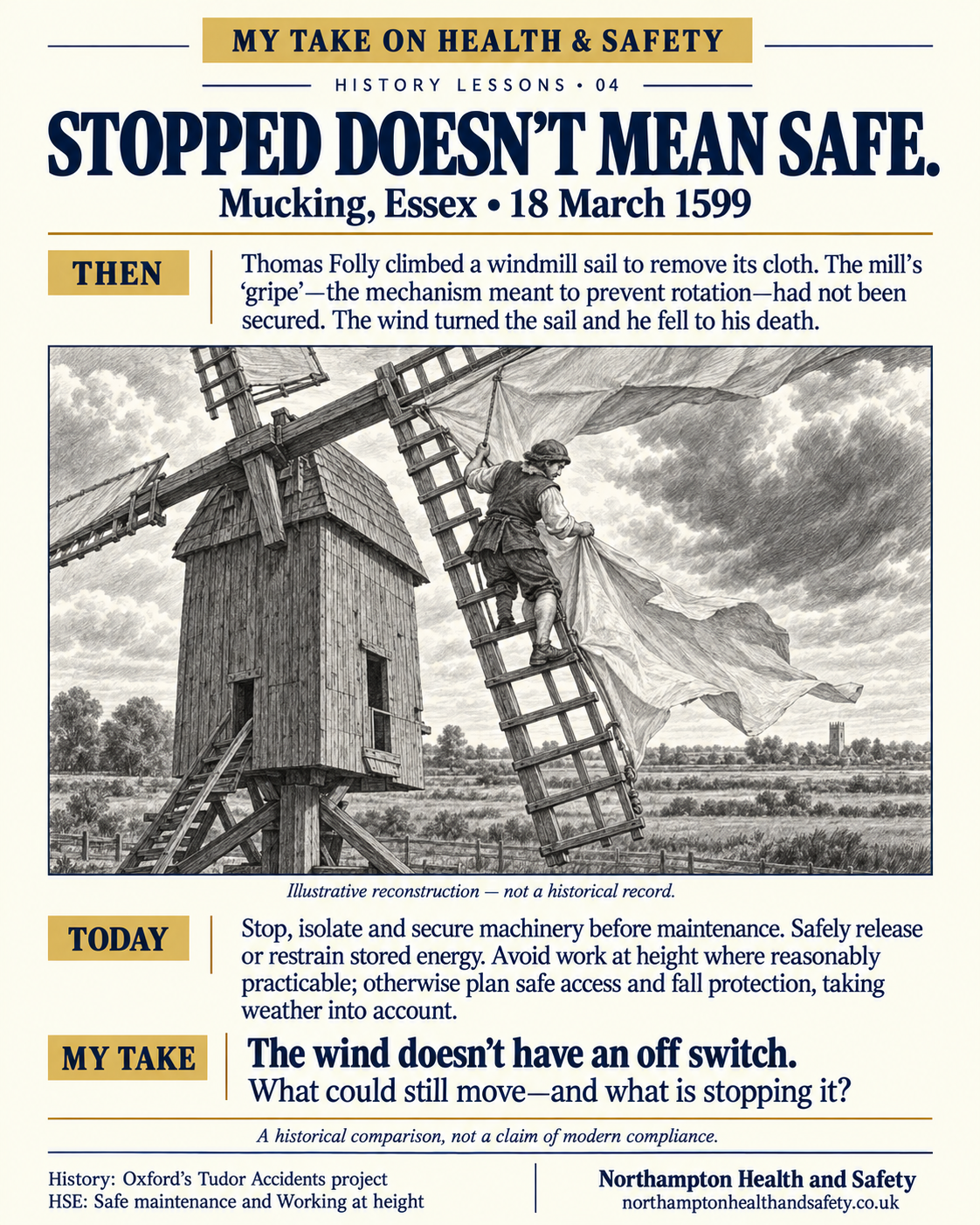
HISTORY LESSONS · 04
Stopped doesn’t mean safe.
Mucking, Essex · 18 March 1599
Then: Thomas Folly climbed a windmill sail to remove its cloth. The mill’s ‘gripe’—the mechanism meant to prevent rotation—had not been secured. The wind turned the sail and he fell to his death.
Today: Stop, isolate and secure machinery before maintenance. Safely release or restrain stored energy. Avoid work at height where reasonably practicable; otherwise plan safe access and fall protection, taking weather into account.
My take: The wind doesn’t have an off switch.
What could still move—and what is stopping it?
A modern investigation should also ask why the precaution was missed: was it clear and usable, could the task be done from a safer position, and was urgency influencing the work? These are questions for the modern comparison, not findings from the historical inquest.
Sources and further reading
Oxford: Tudor Accidents — March 2021 entry
HSE: safe maintenance in agriculture
HSE: maintenance of work equipment
HSE: working at height — a brief guide
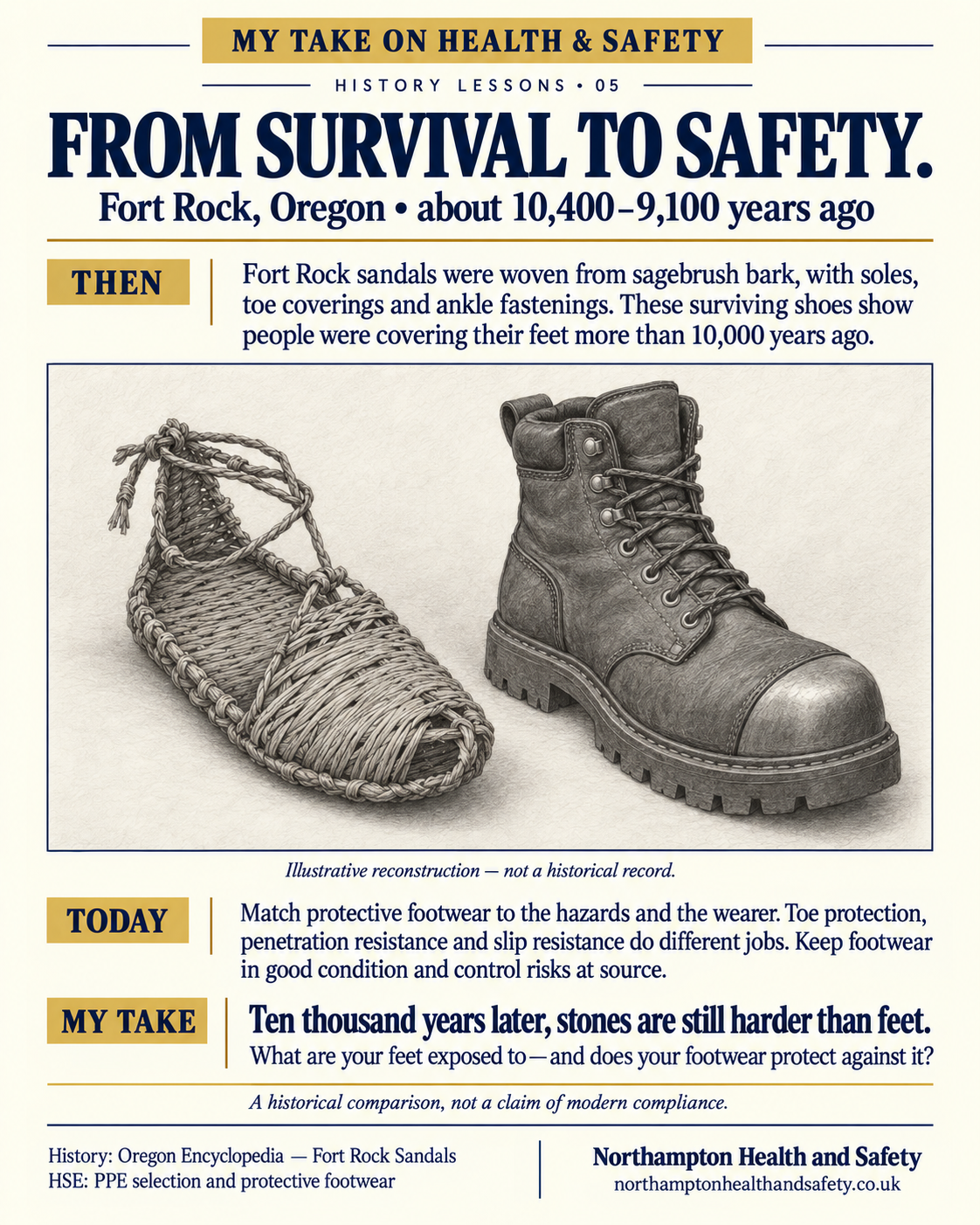
HISTORY LESSONS · 05
From survival to safety.
Fort Rock, Oregon · about 10,400–9,100 years ago
Then: Fort Rock sandals were woven from sagebrush bark, with soles, toe coverings and ankle fastenings. These surviving shoes show people were covering their feet more than 10,000 years ago.
Today: Match protective footwear to the hazards and the wearer. Toe protection, penetration resistance and slip resistance do different jobs. Keep footwear in good condition and control risks at source.
My take: Ten thousand years later, stones are still harder than feet.
What are your feet exposed to—and does your footwear protect against it?
This comparison concerns the idea of putting a barrier between feet and their surroundings. It does not mean ancient sandals offered the protection of modern safety footwear, or that footwear began at Fort Rock.
Sources and further reading
Oregon Encyclopedia: Fort Rock sandals
University of Oregon: Great Basin sandals
HSE: personal protective equipment
HSE: choosing slip-resistant footwear
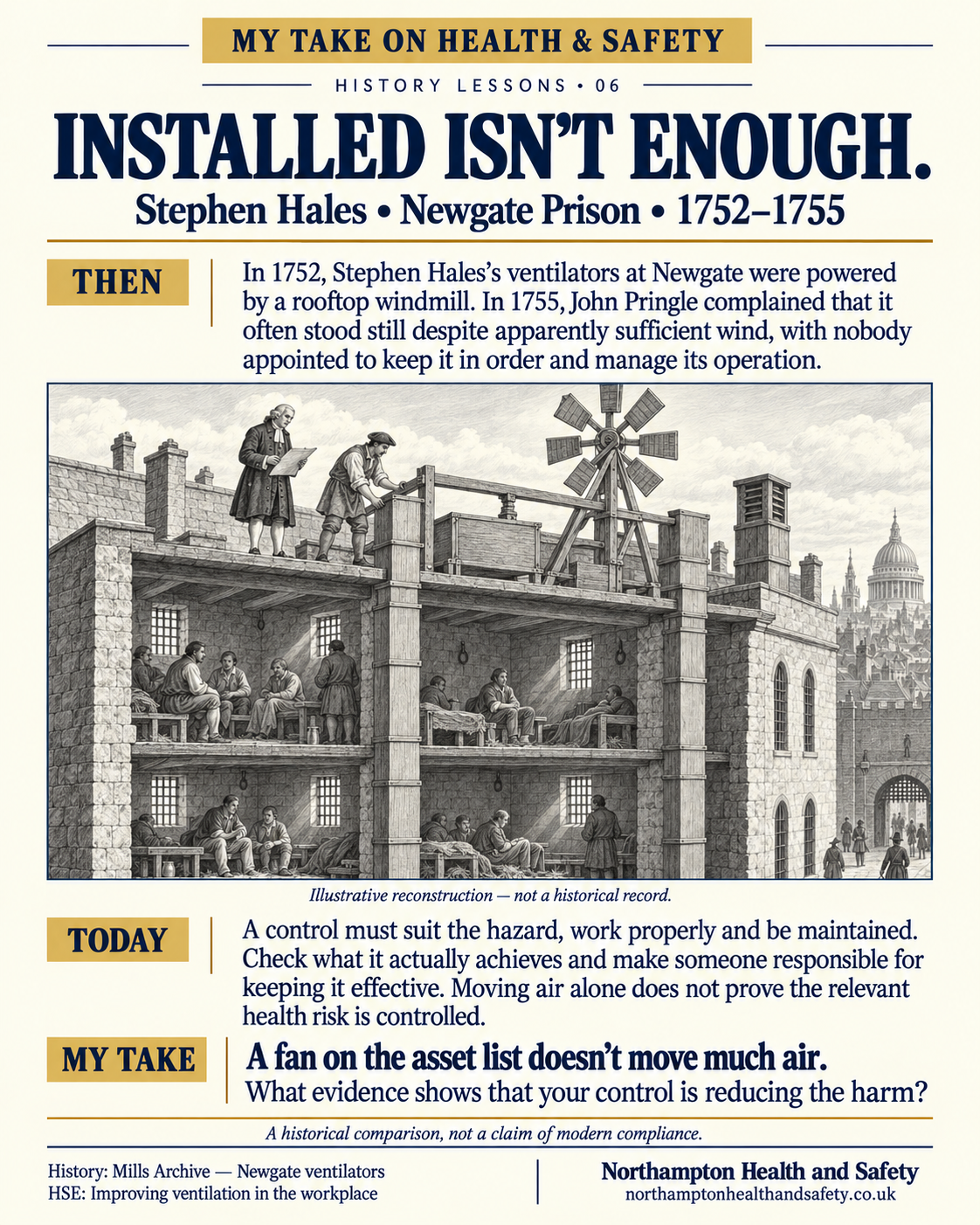
HISTORY LESSONS · 06
Installed isn’t enough.
Stephen Hales · Newgate Prison · 1752–1755
Then: In 1752, Stephen Hales’s ventilators at Newgate were powered by a rooftop windmill. In 1755, John Pringle complained that it often stood still despite apparently sufficient wind, with nobody appointed to keep it in order and manage its operation.
Today: A control must suit the hazard, work properly and be maintained. Check what it actually achieves and make someone responsible for keeping it effective. Moving air alone does not prove the relevant health risk is controlled.
My take: A fan on the asset list doesn’t move much air.
What evidence shows that your control is reducing the harm?
Moving air, improving comfort and preventing a particular disease are different claims. This example concerns whether the equipment was kept operating; it does not establish that ventilation prevented typhus.
Sources and further reading
Mills Archive: Newgate windmill and ventilators
HSE: improving ventilation
HSE: ventilation in the workplace
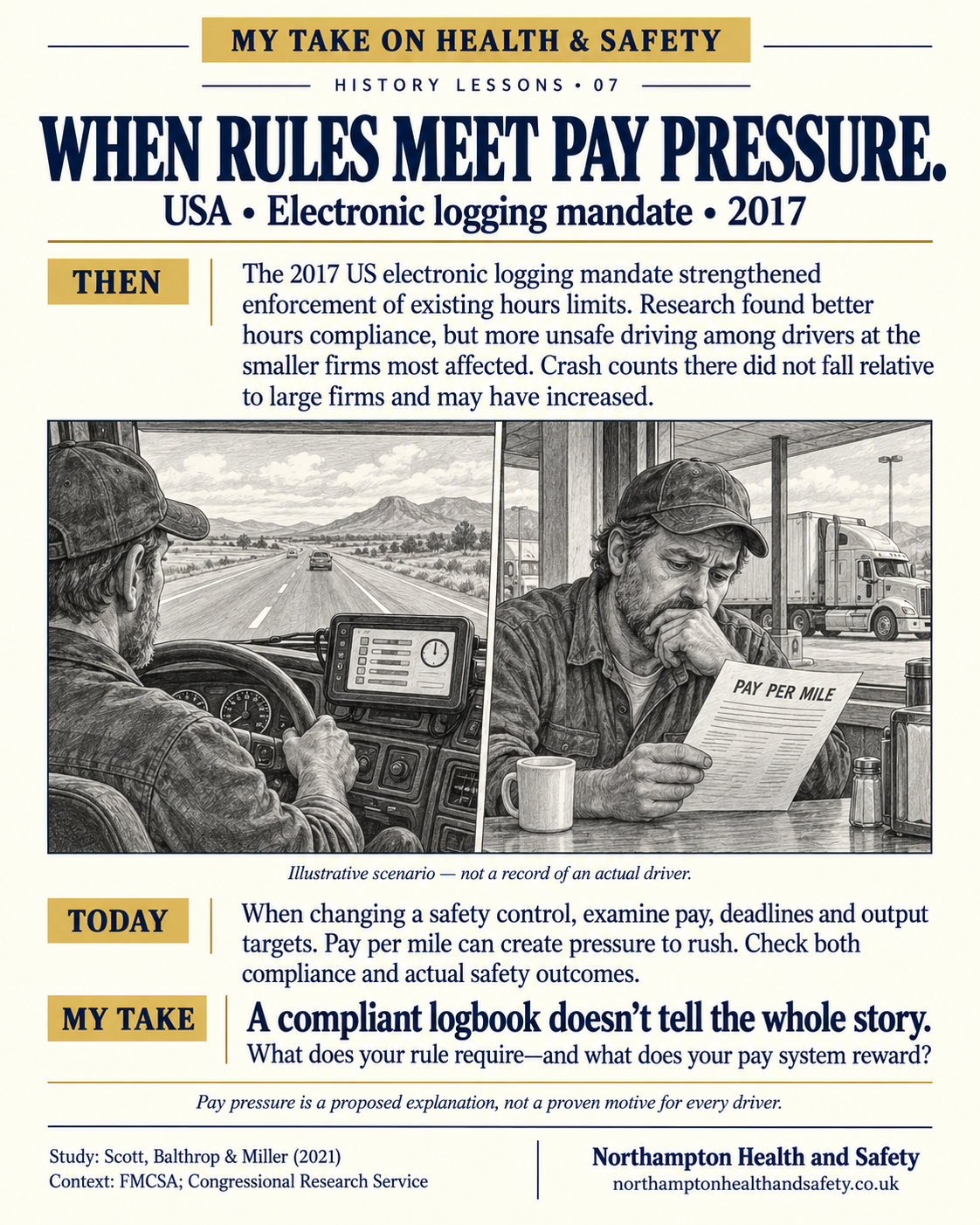
HISTORY LESSONS · 07
When rules meet pay pressure.
USA · Electronic logging mandate · 2017
Then: The 2017 US electronic logging mandate strengthened enforcement of existing hours limits. Research found better hours compliance, but more unsafe driving among drivers at the smaller firms most affected. Crash counts there did not fall relative to large firms and may have increased.
Today: When changing a safety control, examine pay, deadlines and output targets. Pay per mile can create pressure to rush. Check both compliance and actual safety outcomes.
My take: A compliant logbook doesn’t tell the whole story.
What does your rule require—and what does your pay system reward?
Pay pressure is a proposed explanation, not a proven motive for every driver. The findings concern the smaller firms most affected and do not establish a nationwide increase in crashes. The illustration is a scenario, not a record of an actual driver.
Sources and further reading
Scott, Balthrop and Miller: study in the Journal of Operations Management
FMCSA: electronic logging devices
FMCSA: implementation dates
Congressional Research Service: truck driver pay and working conditions
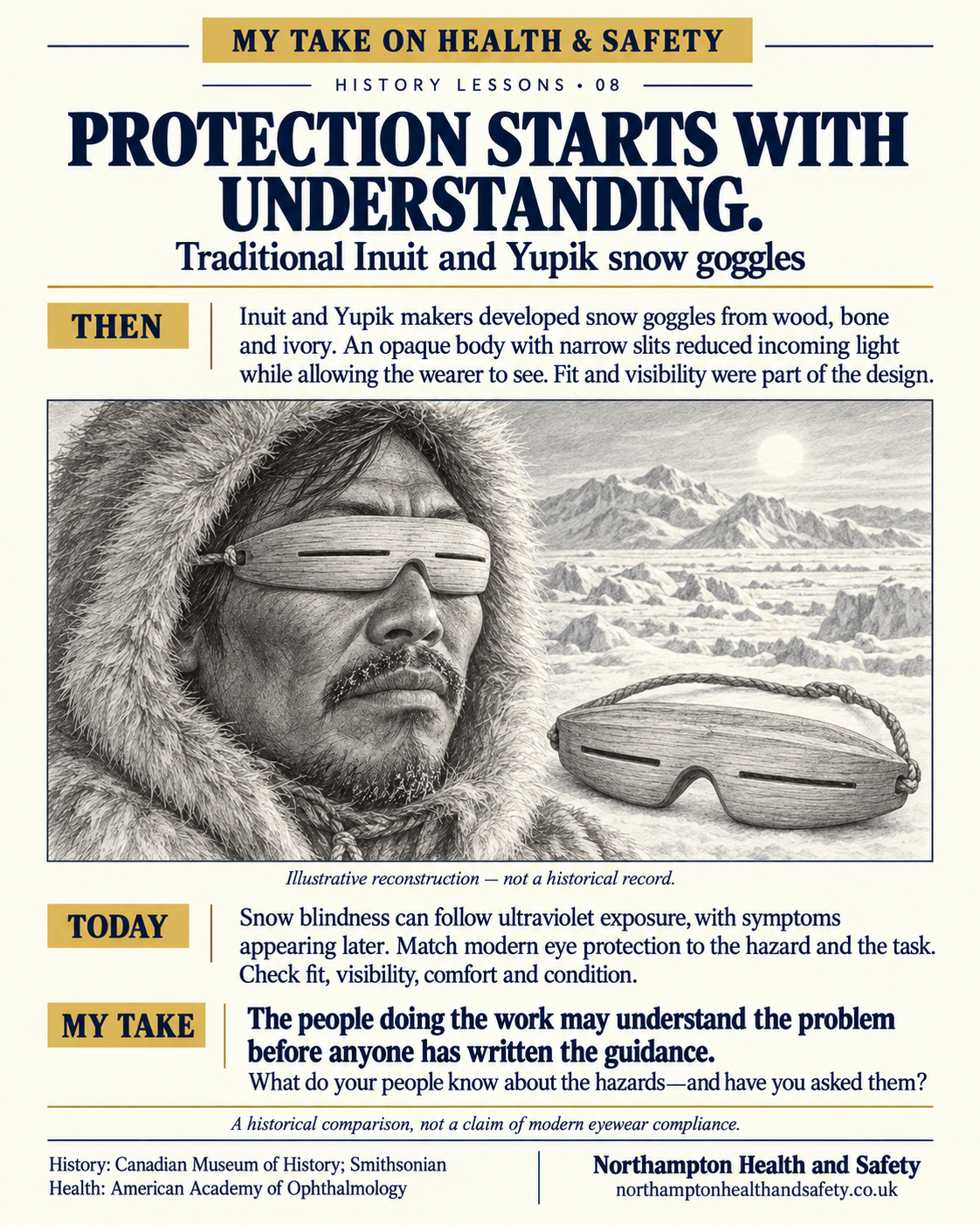
HISTORY LESSONS · 08
Protection starts with understanding.
Traditional Inuit and Yupik snow goggles
Then: Inuit and Yupik makers developed snow goggles from wood, bone and ivory. An opaque body with narrow slits reduced incoming light while allowing the wearer to see. Fit and visibility were part of the design.
Today: Snow blindness can follow ultraviolet exposure, with symptoms appearing later. Match modern eye protection to the hazard and the task. Check fit, visibility, comfort and condition.
My take: The people doing the work may understand the problem before anyone has written the guidance.
What do your people know about the hazards—and have you asked them?
These goggles represent a family of designs developed within different communities, rather than one universal form. The comparison concerns practical knowledge and protective design; it does not establish modern eyewear compliance or suitability for welding. The illustration is a reconstruction, not a record of a particular historical wearer.
Sources and further reading
Canadian Museum of History: snow goggles
Smithsonian: St Lawrence Island snow goggles
American Academy of Ophthalmology: photokeratitis and snow blindness
We’ve done it before—but did we learn?
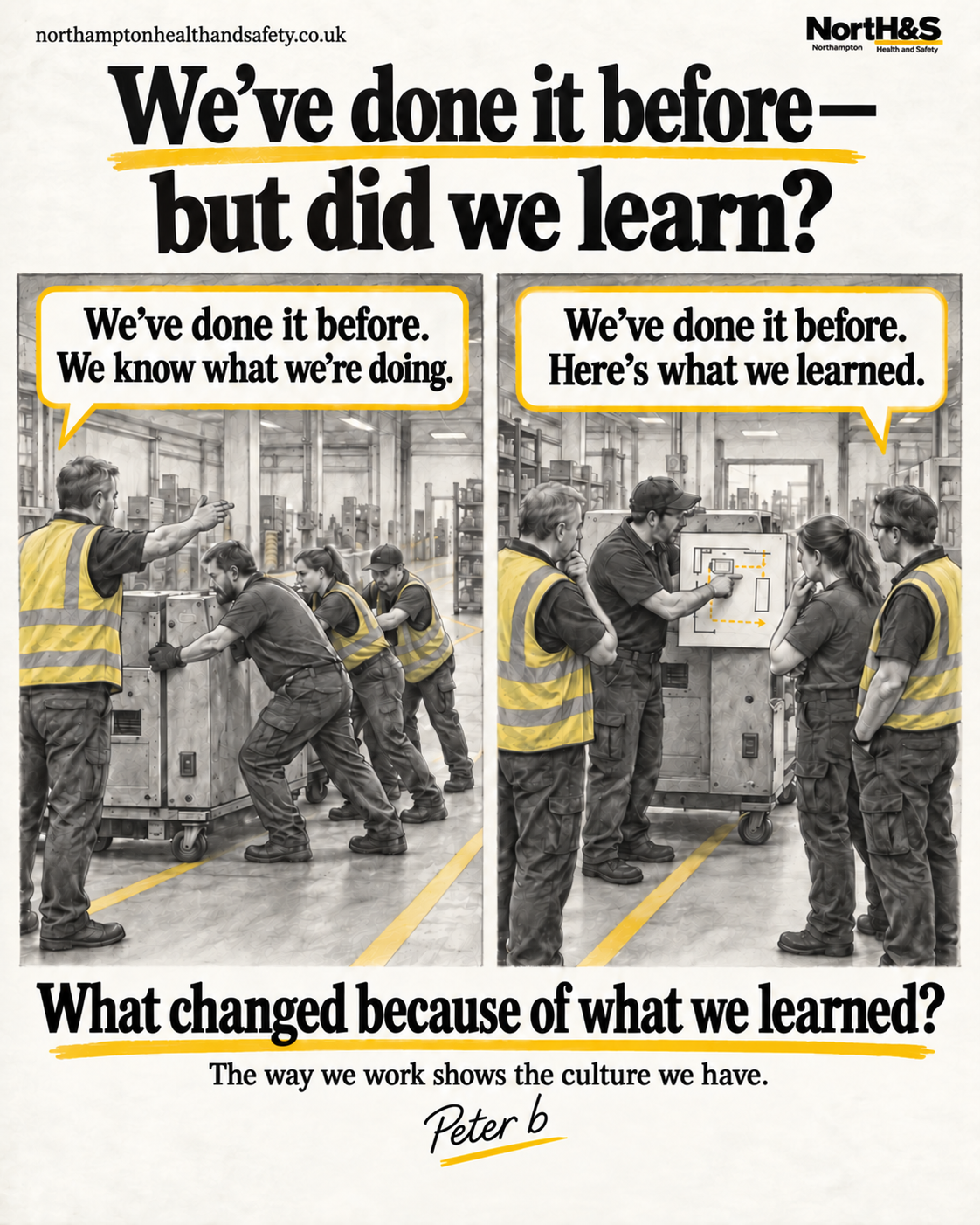
“We’ve done it before. We know what we’re doing.”
“We’ve done it before. Here’s what we learned, and here’s what we need to watch for.”
Two similar statements. Two very different ways of approaching the next job.
People often say, “We have a safety culture,” as though having one is an achievement. But every workplace has ways of doing things: what gets accepted, what gets questioned, what gets passed on and what gets ignored.
That is part of its culture. The question is what sort it has.
It’s rather like someone saying, “This is a quality product.” We tend to hear good quality, although they haven’t actually said that. Calling something a safety culture doesn’t tell us whether people can raise concerns, whether anyone listens or whether experience leads to improvement.
You find those things out by watching how the place works.
The first statement can become a way of closing the discussion.
We’ve done it before. It worked. Let’s get on with it.
But finishing a job doesn’t tell us everything about how it went. Did someone have to make an adjustment? Did something move unexpectedly? Was there a problem that one experienced person quietly dealt with?
And does anybody else know?
I worked at a large food company where one operator knew his machine so well that everyone called it “his machine”.
When he had to go abroad for a funeral, the machine began stopping. People struggled for days to get it running reliably. Eventually, they rang him.
His answer was: “Someone has opened the window in the loft.”
It sounded an unlikely explanation. But the window was open. Air was travelling down through vents and disturbing sensitive parts of the machine’s detection system. When they closed the window, the machine ran properly.
He knew the connection. He would simply go and close the window.
The business knew that he could run the machine. It hadn’t understood everything he did to keep it running.
That experience changed what I asked people. I started looking for the little things they knew about their machines—the adjustments, the warning signs and the things that would catch somebody else out.
The knowledge was there. It just wasn’t necessarily being shared.
That brings me back to the second statement:
“We’ve done it before. Here’s what we learned, and here’s what we need to watch for.”
That might be as simple as explaining that something rolls when released, that a particular stage needs more space, or that the usual arrangement won’t suit today’s conditions.
It also means checking whether the familiar workaround is something we should keep doing, or a sign of a problem we ought to resolve.
This doesn’t have to involve paperwork everywhere or people announcing that they have a learning culture. It can happen in a conversation before the job, a proper handover or someone showing a colleague what to look for. Where an instruction needs recording or changing, that needs doing too.
What matters is that the learning reaches the people who need it and affects what happens next.
New people pick up the way a workplace operates. They notice whether questions are welcomed, whether concerns are brushed aside and whether experienced people explain their reasoning. Over time, those responses become part of “how we do things here”.
That applies to a large company or two people and a dog.
Experience is valuable. But its value to the whole workplace depends on what we do with it.
“We’ve done it before” should be the start of a useful conversation.
What did we learn—and what are we doing with it?
Peter b
Getting Used to It Doesn’t Make It Safe
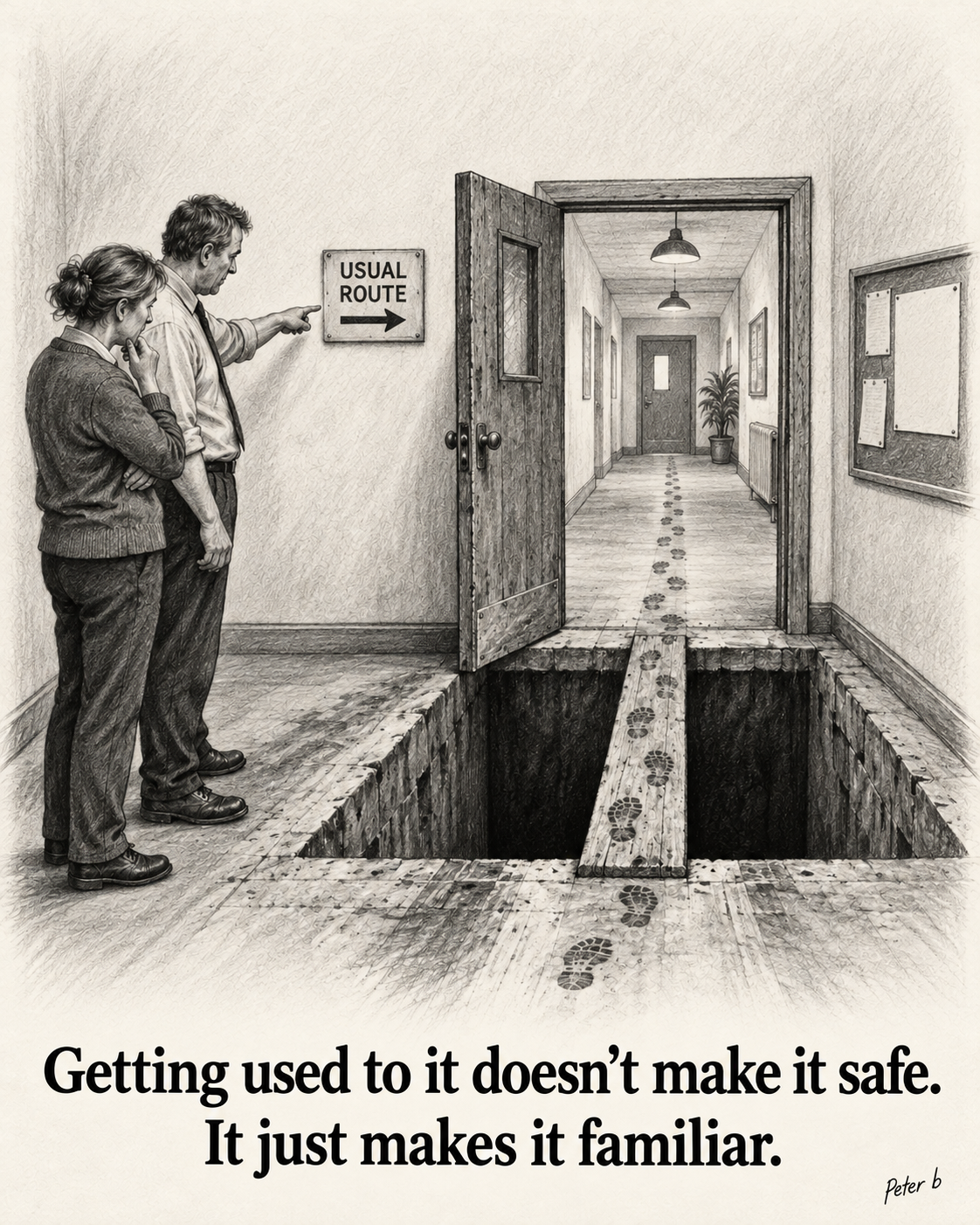
Work can be repetitive. We get used to what we do and how we do it. Familiarity can make us stop questioning it.
Think back to drink-driving. In the 1970s, some people thought a few drinks followed by a short drive home was nothing much to worry about. Public-awareness campaigns challenged that acceptance by showing the harm it could cause.
The danger was there before people took it seriously.
There is a lesson here for the workplace. Seeing something done many times can make it seem acceptable, without telling us whether the risk is properly controlled.
That doesn’t mean every familiar method is wrong. The job may be done correctly, with effective precautions. But we should still be willing to review it.
Has anything changed? Is there new evidence? Have we learned something that could help us do it better?
We have been learning through the ages. There is no reason to stop now.
Getting used to something doesn’t make it safe. It just makes it familiar.
Peter b
Keep the conversation going
Have an example, a different view or a question? Email Peter. You can also explore the free resources for more conversation starters.