
TABLETOP EXERCISES
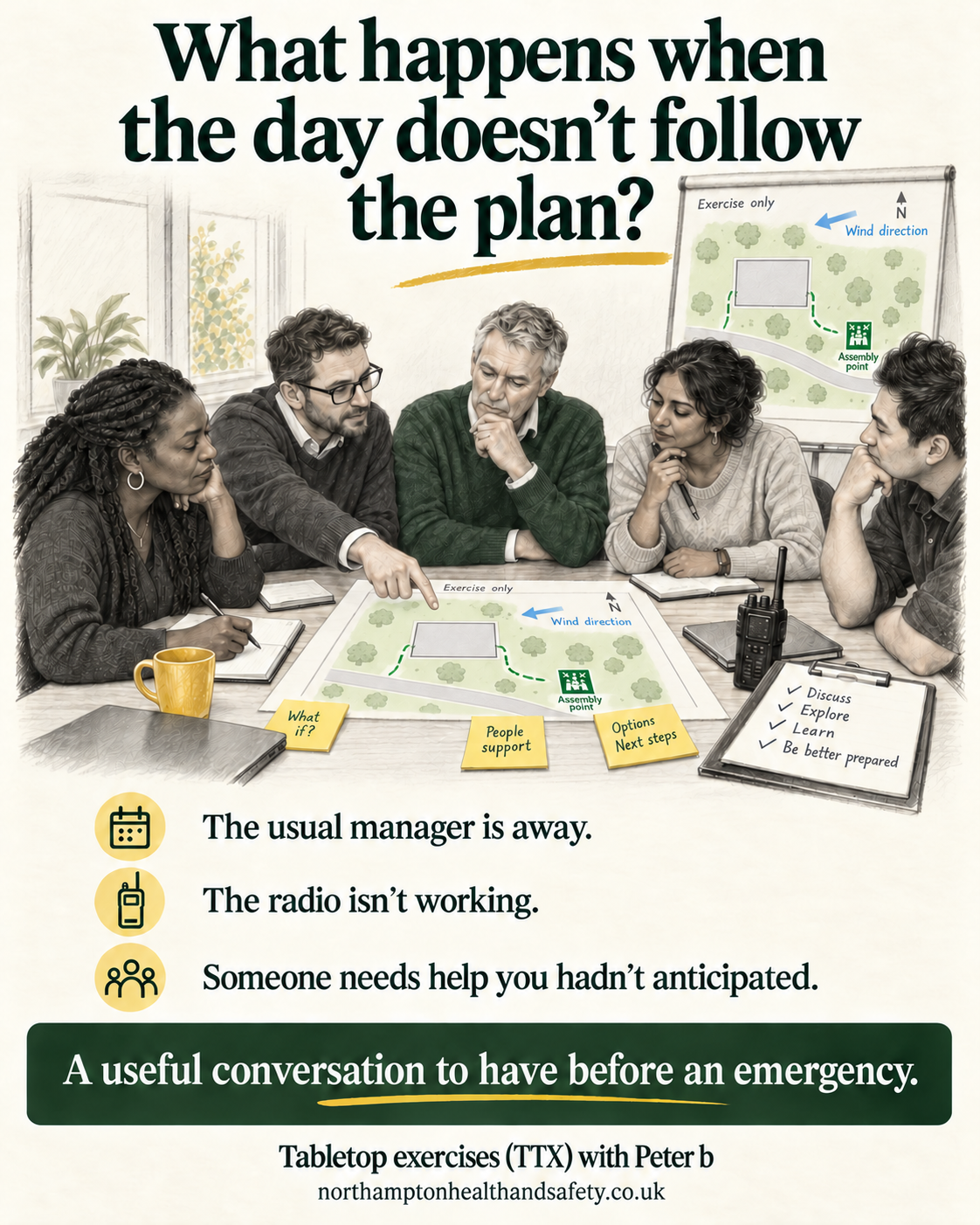
What happens when the day doesn’t follow the plan?
You know your workplace. Let’s explore how your plan works in practice. A tabletop exercise (TTX) brings your team together to explore an emergency scenario relevant to your premises and the people using them.
The usual manager is away. The radio isn’t working. Someone needs help you hadn’t anticipated. These are useful questions to explore before an emergency.
See what a lifeguard’s observation uncovered during a pool exercise.
What is a tabletop exercise?
A tabletop exercise (TTX) brings the relevant people together to work through an emergency scenario. They discuss what they would do, who would make decisions and how information would reach the people who need it.
It gives you time to question assumptions and explore gaps in a controlled setting. It usually needs fewer resources and causes less disruption than a full live exercise, while still requiring preparation and staff time.
How the day works
One day. Two scenarios. Time to think.
A tabletop exercise (TTX) brings your people together to explore how they would respond when the day doesn’t follow the plan.
Beforehand, we agree what you want to test, review your arrangements and walk the site. The scenarios are built around your workplace and the people using it.
On the day, I lead the discussion, supported by a scribe and an exercise controller. We introduce information in stages, explore decisions and record what happens.
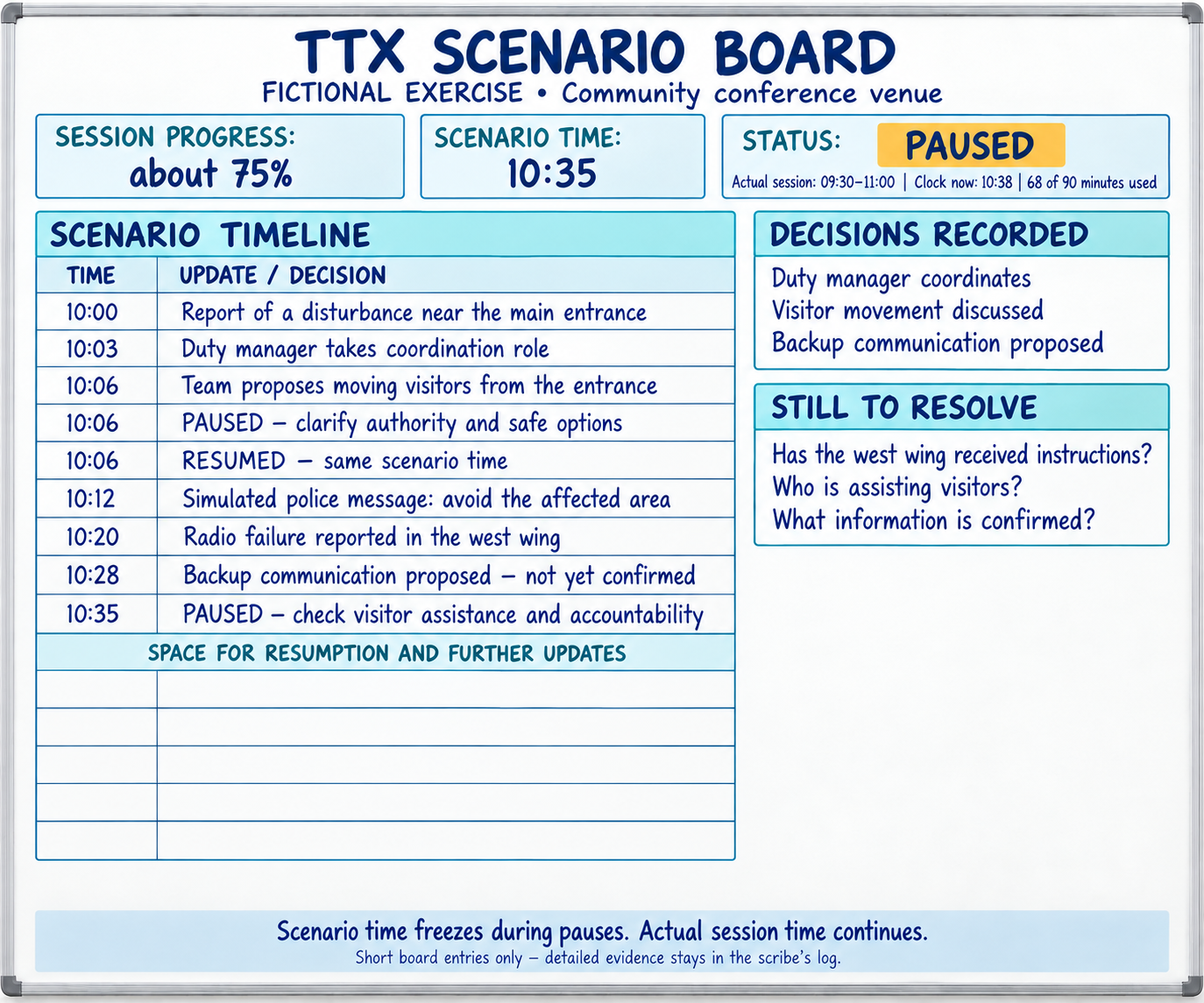
When something needs a closer look, we pause.
The scenario clock stops. We question assumptions, draw on people’s experience and discuss practical options before continuing. The board keeps everyone clear about what is known, what has been proposed and what remains unresolved.
Afterwards, you receive a findings report and an action tracker with agreed priorities, owners and completion dates.
A discussion exercise explores decisions and understanding. Practical drills and equipment checks still have their place.
Test. Discuss. Learn. Put the learning to work.
Peter b
What can it reveal?
- Whether people understand their roles and who has authority to act.
- Whether the plan is clear enough to use as the situation changes.
- Gaps in communication, including what happens if the usual method is unavailable.
- How staff, visitors, contractors and people needing assistance have been considered.
- Where training, responsibilities or procedures need further attention.
The useful question is: can people explain how they would put the plan into action?
My Take: It hasn’t happened here—what does that tell us?
We talk through decisions, responsibilities and communication. There is time to pause, ask questions and draw on the experience of the people who do the work.
What a TTX can uncover
A tabletop exercise brings your plans into a realistic situation—and gives the people involved space to question, discuss and improve them.
FROM AN EXERCISE · AN ANONYMISED EXAMPLE
Through the fire exit—then what?
A lesson from a tabletop exercise
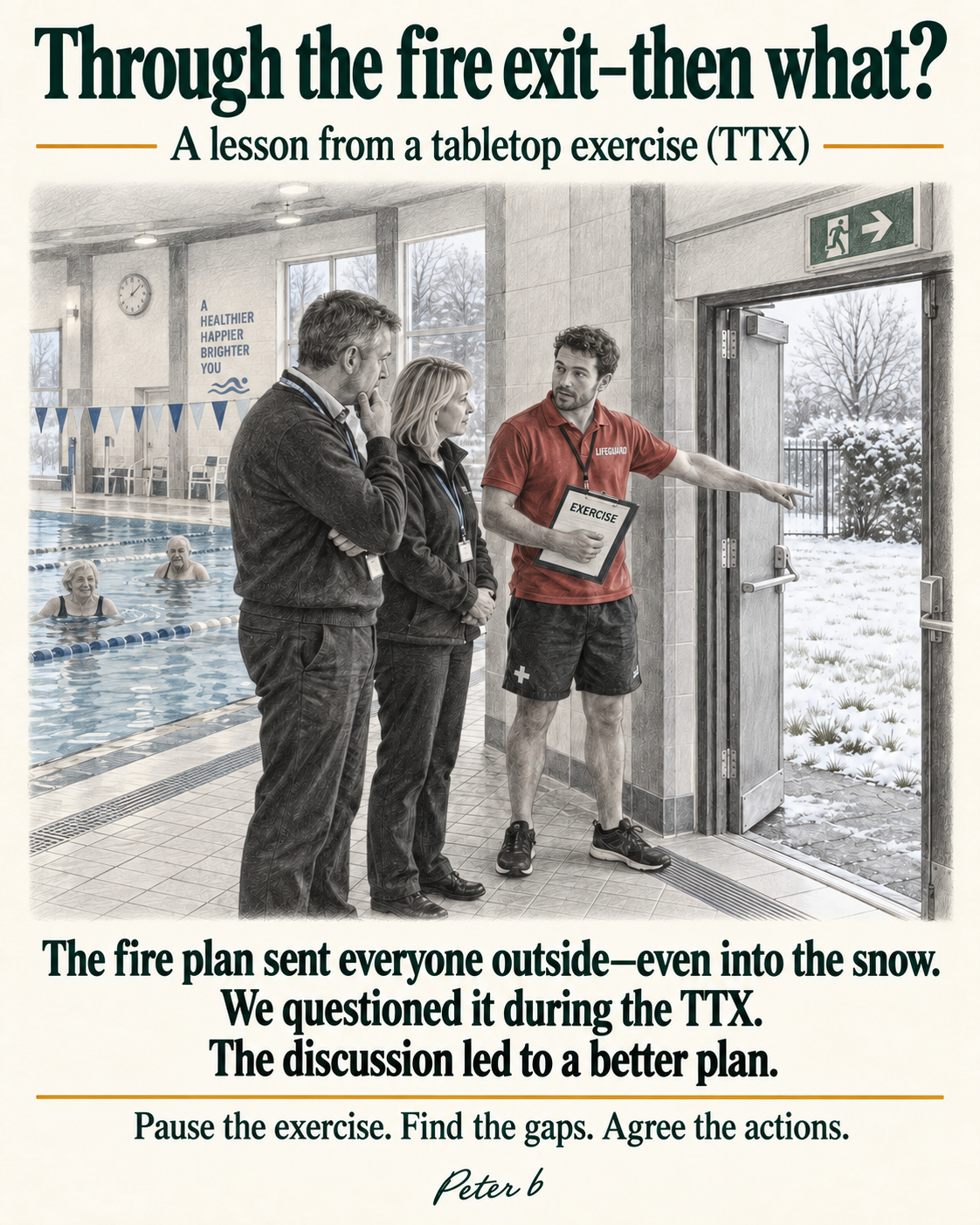
During a TTX at a leisure center, we explored a fire-alarm scenario around the main swimming pool. We had prepared both winter and summer conditions, with the scenario taking place around lunchtime.
Managers and relevant staff were involved, including two lifeguards. As we talked through the response, one lifeguard pointed out that this was normally a swimming session attended by older people, many over 70.
That changed the discussion.
The suggested exit led onto a small grassy area. The swimmers would be wet, wearing swimming costumes and potentially barefoot. What would happen if there were snow on the ground?
Getting people through an exit was only part of the problem. We also needed to consider their safety once they were outside.
We paused the exercise and worked through it.
Foil blankets were suggested. One lifeguard proposed inexpensive hotel-style slippers as another option to assess. We discussed suitable supplies, quantities, storage and how staff could make them available without delaying escape.
Having the lifeguards involved made a difference. They understood the pool’s daily operation and could suggest accessible storage locations close to the exit.
We also explored communication between management and pool staff: what information would be available about the alarm, who would communicate it, and what actions the site’s fire strategy required.
An emergency response needs to follow the arrangements assessed for that building. Where a properly designed staged alarm or phased evacuation strategy applies, staff must understand its signals, responsibilities and escalation. Where immediate evacuation is required, that must happen promptly. These decisions need to be established before an incident.
The discussion became an action list.
People were assigned tasks to assess and obtain supplies, agree storage arrangements, brief relevant staff and update procedures. Those actions then needed following through and checking.
The exercise had exposed a practical gap before anyone was standing outside, wet and cold.
My Take
A plan can look straightforward until the people who do the work explain what it means in practice.
The lifeguards’ contribution brought the scenario to life. Pausing the TTX gave us space to explore the problem, agree actions and identify who would take them forward.
The exercise didn’t just test the plan. It brought together the people who could make it work.
Scenarios to suit your work
Scenarios can include fire emergencies, workplace emergencies, security incidents, terrorist attack response and business continuity events. The scenario should reflect your setting and what you want to examine.
Fire and emergency decisions
A TTX gives your team a chance to discuss who raises the alarm, who makes decisions, how people receive instructions and how changing conditions affect the plan. It can also reveal where different emergency arrangements conflict or leave responsibilities unclear.
Desktop evacuation exercises
A desktop evacuation drill (DTED) uses a plan of your workplace to explore what people would do. Participants can identify an alternative route if their usual exit is unavailable, explain where they would assemble and discuss their responsibilities for helping others.
The exercise can pause to examine a decision and the reasons behind it. That helps reveal whether induction and training have been understood, and where further learning is needed.
These sessions complement practical evacuation drills. See the government guidance on fire drills and training.
Martyn’s Law and preparedness
Martyn’s Law is the Terrorism (Protection of Premises) Act 2025. It concerns qualifying premises and events, with duties that depend on their circumstances. Its public protection procedures cover evacuation, invacuation, lockdown and communication.
A TTX can help teams explore those procedures and their own roles. Paying for a particular course or exercise is not itself a requirement of the Act, and completing a TTX does not by itself demonstrate compliance.
Status checked 2 October 2026: the Act is in its implementation period. Statutory guidance has been published; the substantive duties are not yet in force. Check the Home Office statutory guidance for current scope, duties and commencement information.
Testing the plan and the training
A discussion can show how participants interpret the plan, apply their training and reach decisions within the scenario. Those observations help identify what needs changing or testing further.
Physical performance needs practical testing too. Talking through an evacuation does not establish evacuation times, and discussing a radio call does not confirm radio coverage. Drills, equipment checks and live exercises have their own part to play.
The learning then needs to be put to use: review the findings, agree what needs to change and check whether the changes work. ProtectUK’s exercising guidance explains the different types of exercise and their limits.
What you take away
During the exercise, a scribe works alongside me to record the questions and observations that arise. At the end, we hold a wash-up: a discussion of what happened, what people learned and what needs attention.
We agree actions and who will take them forward. The findings are written up as notes. If you want, I can also put the actions into red, amber and green priority order, helping you decide what to tackle first.
If you want continuing support, I can keep the action list updated and revisit it in later TTX sessions, exploring how the revised arrangements work in a further scenario.
A useful conversation to have before an emergency.
Tell me about your site or event, the people involved and what you want to test. We can discuss an exercise that fits.