Life & Lessons
Stories and lessons from Peter Bushnell
Alone, Together, Apart
A little “what if” about the people we stop noticing.
By Peter b
The Browns had everything they needed to stay connected.
Dave and June had the latest phones. So did their children, Tom and Clair. They had messages, emails and apps for things they had never known needed an app.
There were six televisions in the house.
They were saving for a seventh because sometimes the programmes clashed.
Every morning, the parents went to work and the children went to school. All four spent much of the day talking to The People.
The People lived somewhere beyond the little screens. They sent jokes, photographs, opinions and pictures of their lunch. The Browns sent pictures of their lunch back.
They knew what The People were eating, buying, watching and thinking.
Around them, other figures moved.
Grey shapes in the street. Grey shapes in shops. A grey shape holding a door open. Another clearing a table.
The Browns hardly noticed them.
Once, a group of grey figures gathered around someone lying on the pavement. Dave took a photograph and sent it to The People.
By the next turning, replies were arriving.
He looked down to read them.
At home, each member of the family found a screen and settled in front of it. Sometimes they sent messages to one another from different rooms.
Meals were eaten wherever they happened to be.
If the food looked particularly good, they photographed it before it went cold.
The televisions showed them better kitchens, better clothes and happier people with whiter teeth. There was always something new that would improve their lives.
Dave and June worked longer hours to buy it.
They bought machines to save time. Machines to wash, dry, cook, mix, heat and switch other machines on.
Then they worked more hours to pay for the machines and the electricity to run them.
They were saving a great deal of time.
Nobody seemed to know where it was going.
Eventually, they bought the television they had been waiting for.
It covered most of the wall.
One evening, all four sat together to watch a programme about the countryside. A sunrise filled the room.
The picture was extraordinary.
A man on the screen spoke quietly about the cold before dawn. He described the damp grass, the smell of the earth and the first warmth of sunlight.
The Browns watched from their warm room.
They could see every blade of grass.
They could feel none of it.
Then the screen went black.
So did the lights.
For a moment, nobody moved.
Dave reached for his phone. June checked hers. Tom pressed a button on the remote, harder this time, as though the television might respond to a little firmness.
Nothing.
There were still batteries in the phones, but no messages came through. The internet had gone too.
The house made unfamiliar sounds.
A chair creaked. Somewhere, a tap dripped.
“What do we do now?” asked Clair.
Nobody had an answer.
The first evening was irritating.
The second was worse.
By the fourth day, they needed to go shopping.
Outside, something had changed.
The grey shapes had faces.
A woman passing their gate said good morning. Dave looked behind him before realising she meant him.
“Morning,” he replied.
It felt oddly unfamiliar.
At the shop, people stood talking. Nobody was holding a phone between themselves and the person beside them.
The shopkeeper explained that the power would be off for a month.
“A month?” said June.
“That’s what they’re telling us.”
Dave stayed to ask another question. Then somebody asked him one.
Before long, he was explaining where they lived.
“I’m Dave, by the way.”
“June,” said June.
Tom and Clair introduced themselves too.
They bought what food they could, paid in cash and walked home discussing the people they had met.
Over the following weeks, they did things by hand.
Some were satisfying. Some were a nuisance. Washing up did not become wonderful simply because there was no television.
But they talked while they did it.
They found a board game someone had given them years earlier. Halfway through, there was an argument about the rules.
Then there was laughter.
One evening, June remembered the sunrise.
“We could go and see one.”
“We’ve seen one,” said Tom.
“On the television.”
Nobody spoke for a moment.
Then Clair said, “Where would we go?”
The shopkeeper knew a field at the edge of town.
“Get there before the sun,” he told them. “You’ll miss half of it otherwise.”
So, early one morning in April, the Browns left the house while the street was still dark.
Without the streetlights, the sky seemed larger.
They walked close together. The air was cold and damp, finding its way into collars and cuffs. Dave wondered whether this had been such a good idea.
By the time they reached the field, a pale line had appeared above the horizon.
They stopped beside the gate.
Slowly, the black sky softened into deep blue. A little colour caught the undersides of the clouds.
Somewhere in the hedge, a bird began.
Another answered.
The Browns stood listening.
As the earth turned, a bright edge appeared beyond the field. Light reached across the grass towards them.
Their breath showed in the cold air.
Then they felt warmth on their faces.
Clair lifted her hands towards it.
“Quiet,” said Dave, although nobody was talking.
A faint hum rose from the field. Birds moved above the crop, dipping and turning as the morning became busy around them.
There was more happening than they could watch at once.
Tom noticed a man coming towards them.
“Morning!” he called from some distance away.
He was carrying four mugs, two in each hand, his fingers hooked through the handles with the ease of long practice.
“The wife thought you might like some tea.”
They each took a mug.
The warmth felt good against their fingers.
The man reached into his coat pocket and produced a small packet of sugar and a spoon.
Tom was particularly pleased to see those.
“I saw you arrive,” the man said. “Thought I’d leave you to enjoy it for a bit. We sometimes take it for granted, living here.”
June told him about the enormous television and the sunrise they had watched before the power went.
He looked across the field.
“Yes. I’ve seen one on the television.”
He took a moment.
“Not quite the same, is it?”
They stood together, drinking their tea.
For once, none of the Browns had taken a photograph.
When the electricity returned, they were pleased. The washing machine had been missed. There were friends to contact and messages to catch up on.
But the following morning, Dave looked up as he passed the shop.
“Morning,” he said.
This time, he knew the shopkeeper’s name.
Just Fly The Plane
By Peter b
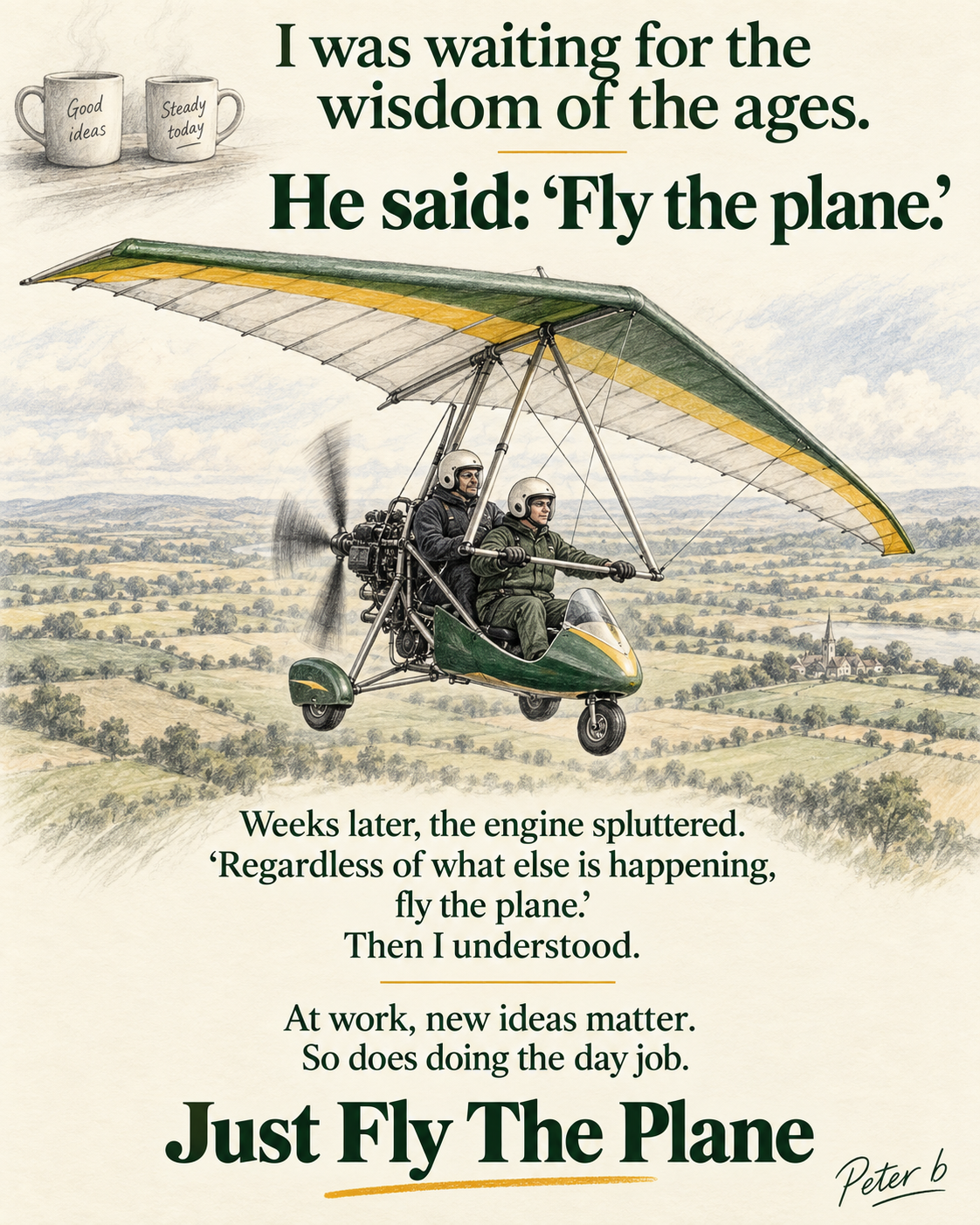
In the late ’90s and early 2000s, I was learning to fly a microlight.
One day, the wind kept us on the ground. Over coffee, my instructor—an experienced former military pilot—said he was going to tell me something very important about flying.
I leaned in, ready for the wisdom of the ages.
“Fly the plane.”
I waited.
He went to make another coffee.
A few weeks later, we were heading back towards the airfield when the engine started spluttering. As a learner, that certainly got my attention.
He said, “Regardless of what else is happening, fly the plane.”
Now I understood. Deal with the problem, but keep flying the aircraft while you do it.
Years later, one of my bosses would listen to my latest idea and say:
“That’s great, Peter. Just do the day job first.”
Fair point. I can get carried away with an idea.
In health and safety, there’s always another gadget, another system, another thing promising to tell us something.
Meanwhile, do people understand the job? Are the controls working? Has the problem someone reported actually been sorted?
I like new ideas. But they need to help us do the essential work—and I need that reminder myself sometimes.
Just Fly The Plane
The hi-vis nobody could see
While working for a large food company, I went over to one of our sites to help an audit run smoothly. Those who’ve been there will know what that involves!
Lorries were being loaded outside, and I was walking along the pavement with the transport manager. The site rule was that anyone working outside had to wear safety boots and a hi-vis top, including on the pavement.
A forklift driver came past wearing a big black coat. It was cold, so the coat was understandable. But where was his hi-vis?
We stopped him and asked.
He got off the forklift and indignantly explained that he was wearing it. Then he took off his black coat to prove it.
There it was. Underneath.
At first, we both laughed a little. The transport manager helped him understand that the hi-vis needed to be on the outside, where people could see it.
But afterwards, I thought about what had happened.
We had told people they must wear hi-vis. We hadn’t actually said it needed to go over their other clothing. Had we properly explained what it was for?
We employed people from around the world, with different backgrounds and experience. I couldn’t assume everyone was familiar with hi-vis or understood how it helped.
As far as that driver was concerned, he was wearing what we had told him to wear. He could even show us.
That was a lesson for me.
Something being obvious to me doesn’t mean it is obvious to everybody else.
I need to explain what we’re asking people to do, why it matters, and check that they understand.
Otherwise, we can end up with someone wearing high-visibility clothing that nobody can see.
Through the fire exit—then what?
During a TTX at a leisure centre, we talked through a fire-alarm scenario at the swimming pool. A lifeguard pointed out that the lunchtime session was attended by older swimmers, many over 70.
The suggested exit led onto a small grassy area. The swimmers would be wet, in swimming costumes and potentially barefoot. What if there were snow on the ground?
“We agreed that sending wet swimmers out into the snow in their seventies wasn’t quite the ‘place of safety’ we had in mind.”
We paused the exercise. The lifeguards helped us discuss possible supplies, practical storage and communication with management. Proposed blankets and slippers needed assessing, and people were given actions to take forward.
Getting through an exit was only part of the problem. The site’s assessed fire strategy also had to work for the people using the building, including their safety after leaving.
A plan can look straightforward until the people who do the work explain what it means in practice.